














Education has not exactly been at the forefront of the presidential campaign. It received far less than even 15 minutes of fame during the first debate, but stand-ins for President Barack Obama and GOP challenger Mitt Romney explored it in depth last night in a debate that revealed sharp philosophical and policy differences between the two candidates.
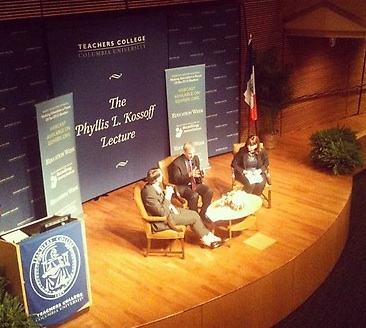
Presidential candidates’ education surrogates. Left to right: Phil Handy, Jon Schnur and moderator Susan Fuhrman. Photo by Justin Lam. (Click to enlarge)
Jon Schnur, President Obama’s surrogate, co-founded America Achieves and New Leaders for New Schools. Phil Handy, Gov. Romney’s stand-in, is former chairman of the Florida State Board of Education and CEO of Strategic Industries. Susan Fuhrman, president of Teachers College, Columbia University, moderated the 90-minute debate, which was webcast.
Although much has been made of their similar positions on charter schools and teacher evaluations, mainly because the president has, on those issues, broken with the Democrats’ traditional alignment with teachers’ unions, their disagreements far outweigh their agreements.
From the start, the debate focused on those differences, beginning with school choice, a euphemism for vouchers. Romney would make school choice a cornerstone of his education policy, said Handy. “We believe that no child should be obligated to go to a failing school just because they were born in a certain zip code,” he said.
In a white paper, Romney has proposed a voucher system that would disburse the $25 billion in federal Title I funds for low-income students and IDEA funds for students with disabilities directly to the students’ families to spend at the school of their choosing, including other public schools, charters, and private schools. “We think there needs to be some disruption in the system and choice is part of that,” said Handy.
Schnur responded that the program isn’t a meaningful option because poor families would only receive a few thousand dollars at best. He said it would be like telling a “a low-income child in a Title I school in the Bronx that that you can go to school in the suburbs,” but not provide enough money to pay for transportation.
“If you have choice without the accountability and funding, it’s not real,” said Schnur. Instead, he said the Obama Administration would require that low-performing Title I schools make dramatic efforts to turn around.
Handy also said that Romney doesn’t support the Obama administration’s waivers from some requirements and penalties under No Child Left Behind. The waiver program releases states from what education officials say is an unreachable goal of having 100 percent of students testing in the proficient range or better in math and English language arts by 2014. In exchange, the states must present plans for raising achievement among low-income students, students with disabilities, English learners, and ethnic and racial minorities. Thirty three states have already received waivers, and 11 are pending, including one from California.
Handy said that letting states set their own accountability standards had led to “racially defining proficiency,” and is setting education back to what former President George W. Bush called the “soft bigotry of low expectations.” An analysis by Education Week of state goals under waivers found a number of them have set “different expectations for different subgroups of students.” For example, Minnesota is requiring 82 percent proficiency in 11th grade math for white students, but just 62 percent proficiency for black students.
Schnur argued that standards under NCLB were always inconsistent from state to state and that’s why Common Core state standards are so important. He said the “low standards we’ve set for our kids have led us to be lying to our kids. Kids around the country were being told that they were proficient based on a mediocre test.”
Not the federal government’s purview
Handy said Romney considers Common Core an opt-in program led by the governors of the 46 states that have agreed to adopt them, and disagreed that the federal government has a responsibility to help fund Common Core curriculum and tests. “I don’t think the federal government should be involved in that,” said Handy.
It was a line of reasoning he used throughout the debate in one form or another, especially when money was involved. “We don’t think, frankly, economic incentives are the purview of the federal government,” he said regarding the president’s multibillion-dollar stimulus package that included funds to pay teachers during the height of the recession. On the subject of early childhood education he said, “We think pre-kindergarten is a good idea,” but it’s not a role for the federal government.
Schnur flipped the argument. He said President Obama’s passion for education and commitment to invest in it, even in tough economic times, demonstrates his “core beliefs and priorities,” and that’s what drives a president’s policies.
He said that Romney’s education policy is “imprisoned” by the budget policy championed by his running mate, Paul Ryan, a budget that calls for a 22 percent cut in non-defense discretionary funding, which could cost states and local governments $28 billion in 2014. About a third of that goes to education, according to the Center on Budget and Policy Priorities.
Although Romney wouldn’t cut the education budget, he wouldn’t add to it either, said Handy, but he was hard-pressed to square that with the Ryan budget cuts. However, the education advisor did single out Pell Grants and argued that the federal government can’t afford to keep funding President Obama’s expansion of the program, which now provides financial aid to 10 million college students, up from 6 million. It may be awarding more money to more kids, but it’s accumulating tens of billions of unfunded liabilities, said Handy.
Some of the other issues covered in the debate include:
- Teachers: Schnur said the president wants to recruit more top quality people into teaching and retain with incentives such as paying off student loans and providing teachers more options for advancement in the teaching profession. Handy said Romney would give Title 2 funds to states in block grants to use for recruiting any groups into teaching that they feel are qualified, such as Teach For America alumni.
- Student Loans: In 2010, President Obama overhauled the student loan industry cutting out the private lenders who worked as middlemen, brokering loans between students and the federal government, and taking a cut. The change will save an estimated $61 billion over ten years. Handy said Romney would reverse that policy. “We would recommend, given our attitude toward competition, that private lenders be put back into the process.” That spurred Schnur to reply, “Having a choice among unaffordable loan is not a choice.”
- Head Start: Handy said Romney wants it to be more of an educational program than a social program. Schnur said the President’s goal is to make better use of existing Head Start funds in part by ending contracts with low-performing Head Start programs.
- Social-emotional wellbeing: Handy said all children can learn regardless of their home lives and social environments as long as their teachers and schools are good. Schnur pointed out that research shows kids living in poverty can succeed in school, but the schools need to address their social and economic challenges and focus on nutrition, health care and social services.
Toward the end of the discussion, Handy repeated Mitt Romney’s refrain from the first presidential debate regarding the strength and success of Massachusetts’ school system when Mitt Romney was governor. That gave Schnur an opening for the best laugh of the night; “I might vote for Mitt Romney for governor,” he quipped, but I don’t think that’s a basis for electing him as president.
To get more reports like this one, click here to sign up for EdSource’s no-cost daily email on latest developments in education.
Comments (2)
Comments Policy
We welcome your comments. All comments are moderated for civility, relevance and other considerations. Click here for EdSource's Comments Policy.
Doug Lasken 12 years ago12 years ago
As anyone who has been following the Common Core Standards knows, the federal government is not giving the states financial rewards for adopting the standards; quite the reverse, CCS entails a substantial penalty to states, which are footing the entire bill, $10 billion nationwide. Nevertheless, Romney and now Handy squander the vote getting potential of the financial story, as Handy (see above) repeats Romney's complaint of two weeks ago that the states are being … Read More
As anyone who has been following the Common Core Standards knows, the federal government is not giving the states financial rewards for adopting the standards; quite the reverse, CCS entails a substantial penalty to states, which are footing the entire bill, $10 billion nationwide. Nevertheless, Romney and now Handy squander the vote getting potential of the financial story, as Handy (see above) repeats Romney’s complaint of two weeks ago that the states are being financially rewarded for adopting CCSSI I’ve written numerous pieces on this, most recently for CA’s pre-eminent GOP site, FlashReport (http://www.flashreport.org/featured-columns-library0b.php?faID=2012101104405213) and emailed the facts to Anna Gatlin, who directs the ed. Policy group for the Romney campaign. It seems Ms. Gatlin, Mr. Handy and Gov. Romney cannot be bothered with noise from outside their circle, even when that noise could deliver thousands of votes in swing states.
navigio 12 years ago12 years ago
Well, I have to admit, I laughed out loud a number of times while reading some of the comments by these 'surrogates'. Then I went to the Romney white paper, and laughed some more while reading it. I dont think either of these candidates has a clue when it comes to public education. It makes sense given that education is a state issue, but maybe they both should stop pretending they know what they're talking … Read More
Well, I have to admit, I laughed out loud a number of times while reading some of the comments by these ‘surrogates’. Then I went to the Romney white paper, and laughed some more while reading it. I dont think either of these candidates has a clue when it comes to public education. It makes sense given that education is a state issue, but maybe they both should stop pretending they know what they’re talking about.
fwiw, I hadnt read Romney’s paper before, but its pretty enlightening.
First off, the high-level description of his plan to promote choice and innovation sounds exactly like would be said to describe NCLB and RTTT and waivers. I did find some interesting specifics:
– Eliminate caps on charter and digital schools
– Replace NCLB-mandated interventions with report cards
– Eliminate tenure
– Evaluations based on performance (test) data
– Remove the ‘highly qualified teacher’ requirement (and maybe credentialling?)
– Welcome private sector participation
– etc..